NASA Seeks Ideas to Extend Hubble’s Mission
NASA Seeks Ideas to Extend Hubble’s Mission
The Hubble Space Telescope is not facing an asteroid impact, sudden explosion, or immediate plunge toward Earth. Its danger is more gradual: after decades in orbit, aging systems could eventually prevent the observatory from operating.
NASA is again seeking proposals for ways to address potentially fatal operational problems and extend Hubble’s scientific mission. The effort does not represent an approved rescue mission. It means the agency is examining whether a crewed spacecraft, robotic vehicle, commercial system, or another technical approach could keep Hubble working safely.
The phrase “certain death” describes the long-term risk of losing Hubble’s ability to conduct science, not an imminent destruction event. NASA must determine whether intervention is practical before a critical failure removes the opportunity to act.
Why NASA Is Seeking Proposals Again
Hubble Faces Aging Systems
Hubble has spent decades exposed to radiation, extreme temperature changes, mechanical stress, and the normal aging of spacecraft hardware. A failure in a critical system could restrict scientific operations or end the mission entirely.
NASA’s challenge is therefore a mission-extension problem rather than a routine maintenance task. The agency must assess possible responses while Hubble remains reachable and enough of its systems continue to function for a rescue concept to be useful.
Available reporting describes potentially fatal operational problems, but it does not establish that Hubble is about to be destroyed or that a single confirmed failure has made a rescue unavoidable. The distinction between serious long-term risk and immediate emergency is important. Source 1
NASA Wants Options Before Choosing a Solution
NASA’s request allows companies, research organizations, and other potential partners to submit technical concepts. These ideas can help the agency evaluate vehicles, rendezvous methods, tools, interfaces, and mission architectures.
Soliciting proposals is not the same as approving a rescue mission. Each concept would still require engineering reviews, cost analysis, schedule evaluation, safety assessments, and scientific-benefit analysis. NASA could study several ideas, reject them all, or select one for further development.
A viable proposal would need to answer several difficult questions:
- Can a spacecraft reach Hubble’s orbit?
- Can it approach the telescope safely?
- Can it connect with an observatory that was not designed for today’s servicing vehicles?
- Can it reduce risk rather than create a greater danger to Hubble or its operators?
Why Hubble Is Difficult to Rescue
Hubble Was Designed for Servicing
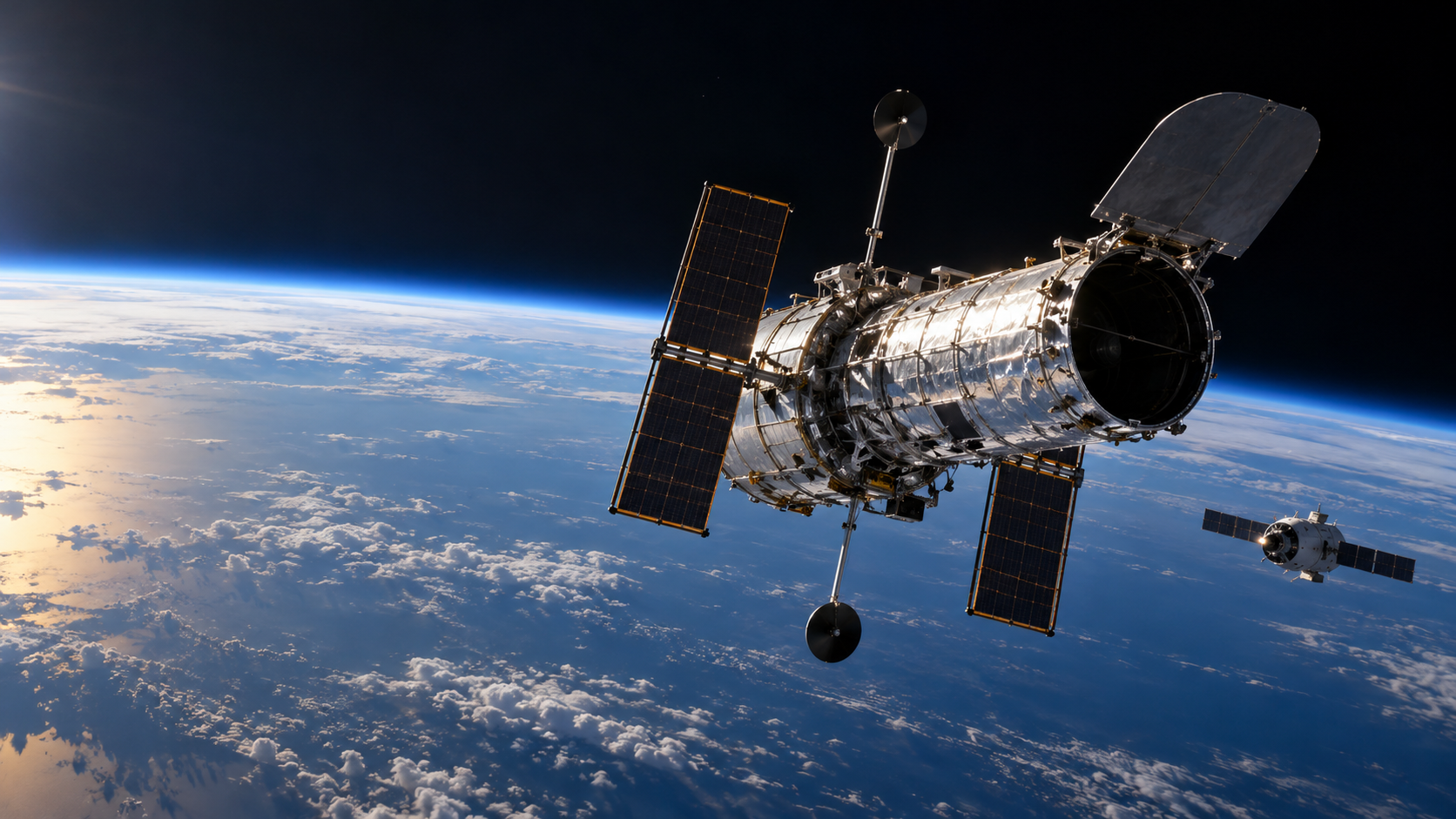
Hubble has an advantage over many spacecraft: its original mission architecture included astronaut servicing. Earlier missions allowed crews to repair systems, replace instruments, install upgrades, and extend the observatory’s useful life.
That history makes Hubble more serviceable than a telescope built without human maintenance in mind. However, a serviceable design does not make a new rescue mission simple. The telescope has aged, the operating environment has changed, and the vehicles once used for servicing are no longer available.
Engineers would need to assess Hubble’s present condition rather than assume that earlier procedures remain possible.
The Space Shuttle Is No Longer Available
Hubble’s previous servicing missions depended on the Space Shuttle. The Shuttle carried astronauts, tools, replacement hardware, and the equipment required to capture and release the telescope.
The Shuttle program ended, removing the system that made those missions possible. A future mission would need another way to reach Hubble, perform close-proximity operations, and interact with its hardware.
Possible approaches could involve a robotic spacecraft, a commercial vehicle, a crewed system, or a combination of technologies. No specific spacecraft should be treated as selected unless NASA formally identifies it. A replacement vehicle would need precise navigation, reliable maneuvering, suitable mechanical interfaces, and enough mission duration for complex operations.
Any Rescue Would Carry Technical Risk
A visiting spacecraft would need to launch into a compatible trajectory, match Hubble’s motion, and approach without creating a collision risk. It would then need to maintain a safe position while accounting for Hubble’s solar arrays, antennas, instruments, and other external structures.
Establishing a secure connection would create another challenge. Aging hardware may be brittle, degraded, difficult to access, or incompatible with modern equipment. Every operation would require detailed procedures, simulations, and contingency plans.
The mission would also need to protect the visiting spacecraft during approach, attachment, repair, and departure. The older Hubble becomes, the more carefully engineers must manage unknown conditions.
What NASA Could Seek in New Proposals
A Vehicle That Can Reach and Support Hubble
NASA may evaluate spacecraft capable of rendezvous and close-proximity operations. Such a vehicle would need accurate navigation, controlled thrust, reliable communications, and software for a complex encounter.
It might also require robotic arms, specialized tools, docking equipment, sensors, or an attachment mechanism. A vehicle designed only to deliver cargo would not automatically be able to inspect, repair, capture, or support Hubble.
Mission duration would matter. The spacecraft might need substantial time to approach Hubble, prepare for operations, perform work, and verify the telescope’s condition.
A Mission to Stabilize or Extend Operations
A proposal could focus on preserving systems required for continued science. Depending on the problem, the mission might stabilize the spacecraft, support degraded systems, replace selected components, or provide temporary assistance.
These are possibilities, not confirmed plans. The required work would depend on Hubble’s specific problems and the condition of its hardware when NASA evaluates the proposals. Some concepts might restore capabilities; others might preserve only limited operations.
A Controlled End-of-Mission Option
NASA must also consider Hubble’s full lifecycle. If continued operation becomes impossible or too risky, a proposal could address safe disposal or controlled reentry.
That would be an end-of-mission plan, not a rescue mission designed to extend scientific operations. There is no indication in the supplied reporting that NASA has decided to deorbit Hubble. Considering that possibility is a normal part of responsible spacecraft planning and does not mean operations are ending immediately.
A Balance of Value and Risk
NASA would likely compare proposals using criteria such as:
- Probability of mission success.
- Protection of Hubble’s remaining scientific capabilities.
- Compatibility with available spacecraft.
- Cost and development time.
- Mission duration and operational complexity.
- Crew safety, if astronauts are involved.
- Long-term scientific value.
An ambitious concept would not automatically be the best option. A smaller mission that preserves limited operations could carry less risk than an extensive repair requiring untested technology.
Why Hubble Still Matters
Hubble observes the universe above Earth’s atmosphere, which otherwise distorts incoming light and limits the sharpness of many observations. Its instruments have supported research on galaxies, star formation, stellar evolution, nebulae, planetary systems, and the expansion history of the universe.
Its long operating history also gives astronomers a platform for follow-up observations. Researchers can compare new measurements with earlier data to study change over time and investigate objects identified by previous surveys.
Newer space telescopes do not make Hubble obsolete. Space observatories use different instruments, wavelength ranges, fields of view, and observing strategies. Hubble is especially important for visible and ultraviolet observations, while other observatories specialize in infrared, X-ray, radio, or other parts of the electromagnetic spectrum.
Losing Hubble would create a scientific gap even if other observatories remained active. No single newer telescope would fully replace its combination of instruments, archive, resolution, observing history, and wavelength coverage.
Hubble is also an astronomical and cultural landmark. Its images have connected research with education, museums, classrooms, documentaries, and popular culture. Decades of observations form an archive that researchers can revisit with improved analytical methods.
Hubble’s Servicing History
Astronauts previously repaired and upgraded Hubble in orbit. Those missions replaced or improved important components and transformed the telescope into a long-running scientific platform. They demonstrated that intervention can work under the right conditions.
Hubble has also survived technical problems that required corrective action. Engineers diagnosed failures, developed solutions, and returned the observatory to productive work.
Past success, however, does not guarantee a future rescue. The Shuttle is no longer available, current spacecraft have different capabilities, and Hubble has endured decades of additional aging. Earlier procedures might require new tools, vehicles, or operating methods.
Questions NASA Must Answer
Can a Vehicle Reach Hubble Safely?
NASA must examine launch capability, orbital matching, navigation, communications, rendezvous, close-proximity control, and departure. Reaching the telescope is only the first stage.
What Needs to Be Repaired or Supported?
The objective must be specific. Hardware repair may require tools, replacement parts, and direct access. Temporary operational support may help Hubble manage a degraded condition without replacing a failed component.
Would Astronauts Be Required?
A robotic mission could reduce crew risk and operate without life-support systems, but robots may face limitations in dexterity, force feedback, tool use, and unexpected repairs. Astronauts could provide greater flexibility but would require extensive life-support, crew-safety, launch, spacecraft, and certification systems.
The current proposal process does not establish that either approach is preferred.
Is Extension Worth the Investment?
NASA must compare the scientific value of additional Hubble observations with the cost and risk of a rescue mission. Funding would compete with other space science, exploration, technology, and Earth-observation priorities.
What Happens Next?
NASA would likely review submitted concepts, select promising ideas for further study, define mission objectives, estimate cost and schedule, complete safety assessments, and decide whether to authorize development.
This is a general decision path, not a confirmed NASA timeline. A request for proposals does not guarantee a mission, launch date, specific spacecraft, crew, or repair plan.
Hubble’s future could follow several paths:
- Mission extension: A feasible concept addresses the operational threat and allows Hubble to collect science for additional years.
- Limited operations: A mission preserves some systems, allowing a narrower range of observations.
- End of mission: No proposal offers an acceptable balance of cost, risk, safety, and scientific value, and NASA manages Hubble’s retirement responsibly.
Conclusion
NASA is seeking ideas because Hubble faces aging-related operational problems that could eventually end or severely restrict its mission. The agency is determining whether the telescope can be safely supported, repaired, or otherwise preserved.
Hubble remains difficult to replace because of its scientific archive, visible and ultraviolet capabilities, cultural influence, and history of successful servicing. The proposal process does not guarantee a rescue mission. NASA must still determine whether any concept is feasible, safe, affordable, and worthwhile.
For now, the agency is exploring options before Hubble’s aging systems close the window for action.
Frequently Asked Questions
Why is NASA asking for ideas to rescue Hubble?
NASA is seeking proposals because Hubble faces operational problems that could eventually end or severely restrict its mission. The request allows the agency to evaluate ways to extend the telescope’s scientific life.
Is Hubble about to be destroyed?
Not necessarily. Available reporting describes potentially fatal operational problems, not an immediate destruction event. “Certain death” refers to Hubble’s long-term ability to operate, not a confirmed imminent disaster.
Could astronauts repair Hubble again?
A crewed servicing mission is one possible concept, but no specific approach is confirmed without an official NASA announcement. Any astronaut mission would face major safety, spacecraft, and technical requirements.
Could a robotic spacecraft rescue Hubble?
A robotic spacecraft could theoretically support or service Hubble, depending on the work required. Feasibility would depend on rendezvous capability, navigation, mechanical access, software, mission duration, and the telescope’s hardware condition.
Why does Hubble still matter if newer telescopes exist?
Hubble observes wavelengths and targets that complement newer observatories. Its long archive, high-resolution observations, and visible and ultraviolet capabilities make it difficult to replace completely.
Has NASA decided to deorbit Hubble?
The supplied source summary does not indicate that NASA has made that decision. The current effort concerns proposals for addressing Hubble’s operational problems and potentially extending its mission.
Artikel Terkait
-
 NASA’s Ghostly Cat’s Head Nebula Image Explained
-
 4.1-Billion-Year-Old Mars Meteorite Found in Sahara
-
 Hell Chicken Was First Known Fruit-Eating Dinosaur
-
 13 Terrifyingly Beautiful Images From Space
-
 Hubble’s Future: Servicing Mission or Controlled Deorbit?
-
 Cape Cod Fireball Linked to Dense, Possible Iron Meteorite