NASA Mars Simulation Crew Returns After More Than a Year
NASA Mars Simulation Crew Returns After More Than a Year
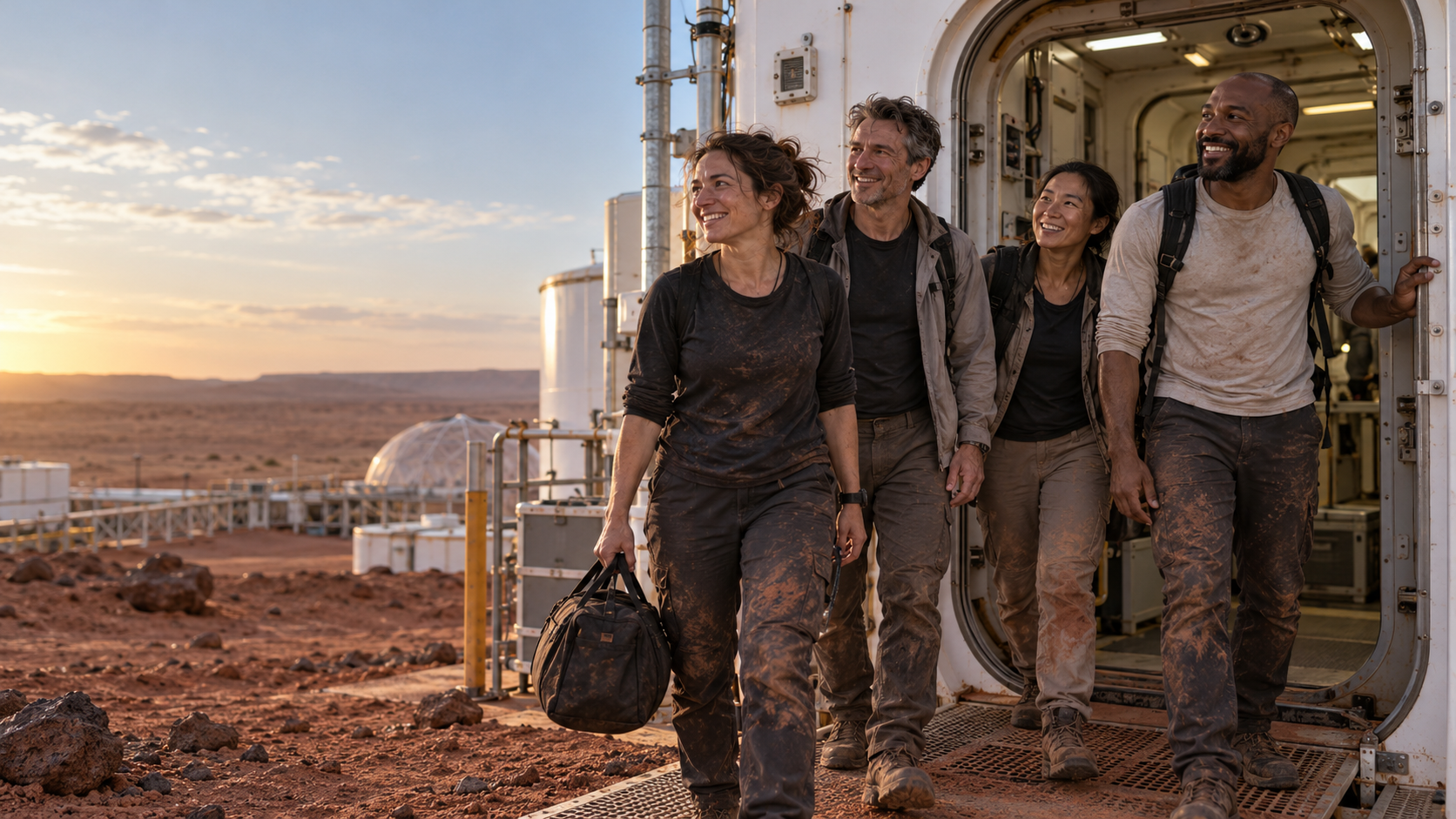
Four people have completed more than a year inside a NASA facility in Houston designed to simulate selected conditions of life on Mars. They did not travel to the Red Planet. They remained on Earth in a controlled habitat while researchers studied the demands of a long-duration Mars mission.
The experiment focused on whether a small crew can remain healthy, productive, and psychologically resilient while isolated from normal life, working with limited resources, and operating with increasing independence.
The participants’ exit ended the simulation’s operational phase, but the research continues. NASA and its partners must analyze data on confinement, routines, work, health, resource management, and relationships over time.
What Was the NASA Mars Simulation?
A ground-based analog mission
The Houston experiment was a ground-based analog mission. Analog missions recreate selected spaceflight conditions on Earth so researchers can study people, equipment, procedures, and operations before committing astronauts to an actual mission.
The participants did not experience Mars gravity, cosmic radiation, launch, landing, or the physical danger of interplanetary travel. Instead, they lived in a controlled environment that reproduced certain human and operational challenges.
A Mars crew would spend months in transit, work on or near the Martian surface, and then face another long journey home. The mission could last years rather than weeks, requiring sustained performance under isolation and limited resources.
A controlled habitat allows researchers to observe how a crew follows routines, manages supplies, maintains health, handles isolation, and responds to the pressures of confinement.
Why Houston was useful
A Houston facility cannot reproduce Mars, but it can provide a contained setting that participants cannot simply leave when conditions become uncomfortable. Researchers can monitor the crew, maintain the facility, respond to medical needs, and collect data throughout the mission.
This approach is safer and more flexible than a real Mars mission. It allows researchers to test systems repeatedly, identify problems, and adjust future mission designs before astronauts leave Earth.
Life Inside the Simulated Habitat
The participants lived and worked inside a confined habitat. The same space served as their home, workplace, exercise area, research station, and social environment.
Privacy was limited, ordinary choices were restricted, and the crew could not take a spontaneous walk or spend an evening away from the group. Meals, work, exercise, recreation, communication, and personal time therefore became important sources of structure.
Habitat design also affects behavior. Narrow passages, shared work areas, storage arrangements, noise, lighting, and equipment access can influence stress and productivity. A minor inconvenience during a short test may become a significant problem after months of repeated use.
The crew also had to perform useful work, including scheduled tasks, equipment checks, maintenance, supply management, and research activities. A successful simulation examines whether people can continue making decisions, solving problems, and cooperating over an extended period.
The Challenges of Long-Term Isolation
Separation and monotony
Separation from family, friends, familiar places, and ordinary public life can create emotional pressure. Communication becomes more important, but it may be scheduled or limited by mission requirements.
Repeated tasks, identical surroundings, and fixed routines can also produce boredom and psychological fatigue. Meaningful work, varied activities, personal time, recreation, and clear goals can help maintain motivation and performance.
Privacy and interpersonal tension
A small crew must resolve disagreements without the option of leaving the habitat for an extended period. Differences in work style, communication habits, cleanliness standards, energy levels, and expectations may become more visible in a shared environment.
Crew selection and training are therefore as important as hardware. Astronauts need technical expertise, communication skills, emotional awareness, and conflict-resolution strategies. Leadership must support clear responsibilities, decision-making, and early intervention when a crew member is struggling.
Health and resource management
Physical health supports every other mission activity. Sleep, exercise, nutrition, stress management, and recovery affect research, maintenance, judgment, and emergency response.
Researchers can study sleep, activity, mood, stress, nutrition, and social interaction across a long period. They can also examine how resource limits affect routines, morale, planning, waste, and decision-making.
The simulation cannot reproduce microgravity, Mars gravity, radiation, launch, landing, or interplanetary travel. It can still provide useful evidence about health routines and human behavior inside an isolated habitat.
Why Mars Missions Need Experiments Like This
A Mars expedition would involve launch, transit, arrival, surface operations, and the return journey. Astronauts could remain away from Earth for years while maintaining equipment, conducting research, protecting their health, and making decisions under changing conditions.
Communication delays would prevent mission control from providing instant instructions. The crew might need to diagnose a problem before Earth received the first report. This would affect medical decisions, troubleshooting, scheduling, and emergency response.
A Houston analog cannot reproduce the full communication delay or the experience of seeing Earth from deep space. It can test whether a team follows procedures, works independently, manages resources, and maintains performance in a controlled mission environment.
Every system must also be usable by people who may be tired or stressed. Life support, food, exercise, medical, maintenance, and waste-management systems must work together with human schedules and capabilities.
What Researchers Can Learn
Researchers can examine whether participants maintained concentration, productivity, cooperation, and adherence to routines throughout the mission. A year-long data set may reveal changes that short tests miss, including patterns in sleep, motivation, health, stress, and team performance.
Participant feedback can also expose design problems. A storage location may be inconvenient, a tool may be difficult to maintain, or a work area may create unnecessary noise. Small improvements can reduce frustration and save time during a long mission.
The study has clear limits. It cannot fully predict how every astronaut would behave on Mars or reproduce the physical and psychological realities of deep space. Its value lies in isolating specific challenges, including confinement, teamwork, resource management, routines, and habitat operations.
What Happens Next?
The participants’ departure ended the simulation but began a new research phase. NASA and its partners will review mission data, compare performance across the full period, evaluate participant feedback, and study the transition back to ordinary life.
The findings could influence:
- Crew selection and training
- Psychological support
- Work and rest schedules
- Exercise and health monitoring
- Food and supply planning
- Habitat layouts
- Equipment design
- Emergency procedures
- Crew autonomy and communication protocols
One simulation cannot answer every question about Mars. NASA will need additional analog missions, field tests, habitat studies, robotics research, medical work, and life-support testing.
Conclusion
Four people spent more than a year inside a NASA habitat in Houston, living under selected conditions associated with a long-duration Mars mission. They have now left the facility, but the experiment continues through data analysis.
The mission did not recreate Mars. It did not reproduce radiation, reduced gravity, launch, landing, or the full psychological reality of deep space. It addressed a different question: how people function over time when they must live, work, cooperate, maintain their health, and manage resources in an isolated environment.
Future Mars crews will need advanced spacecraft and reliable life-support systems. They will also need sustainable schedules, carefully designed habitats, clear procedures, and teams capable of resolving conflict and making independent decisions.
Frequently Asked Questions
How long did the participants spend inside the simulation?
They spent more than a year inside the simulated Mars habitat in Houston. The available report confirms the duration broadly but does not provide a more precise figure.
Did the participants travel to Mars?
No. They remained inside a NASA facility in Houston and simulated selected conditions associated with a long-duration Mars mission.
Why does NASA simulate Mars missions on Earth?
Ground-based simulations allow researchers to study isolation, confinement, crew dynamics, resource management, health, routines, and operational decision-making before sending astronauts into deep space.
Can a Houston simulation fully recreate life on Mars?
No. It cannot reproduce Mars gravity, cosmic radiation, launch, landing, interplanetary distance, or the complete psychological reality of a Mars expedition. It can still provide useful evidence about human behavior and habitat operations.